
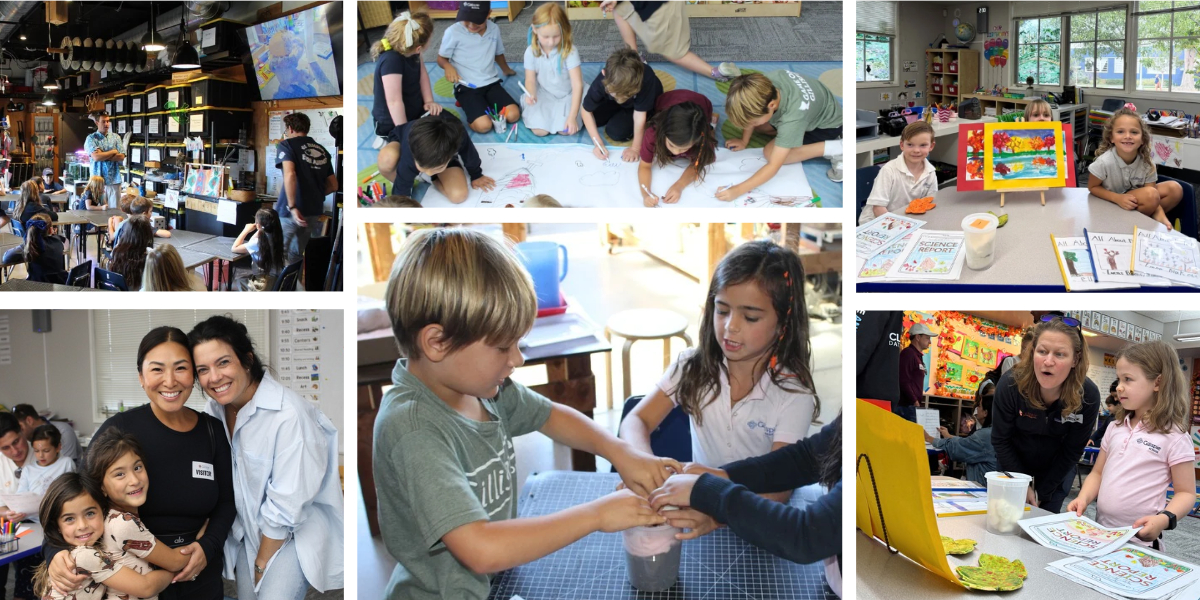
Grade 1 teachers collaborated closely with specialty teachers and Mr. B, Gillispie’s Innovation and Design Coordinator, to create a rich learning experience inspired by the season of fall. The project was part of the school’s innovation initiative, which encourages students to approach learning with curiosity, creativity, and a willingness to test their ideas.
As part of their Bookworms curriculum, students explored how leaves change color and how animals prepare for winter. Their science studies introduced them to plant parts, including seeds, while in Art with Ms. W., they created mixed-media fall trees with reflections, ceramic leaf plates, and vibrant watercolor turkeys.
The classroom conversations soon sparked a new question. During a morning meeting, students shared what they knew about animals storing food for winter, including that squirrels store acorns in trees. This led to a discussion about how trees can insulate acorns and keep them from getting too cold. Mr. B. joined the conversation to explore the innovator’s mindset, focusing on curiosity and how scientists begin by asking questions. Together, the students wondered: What materials might help keep acorns warm, and how could they find out which works best?
In the Science Design Makerspace, students turned their questions into an experiment. One class chose cloth, foam, and dirt to test; the other chose cloth, foam, and marshmallows. Each group packed one material around a 3D-printed acorn and thermometer inside a plastic container. Students recorded the temperature, placed the containers in a refrigerator for 10 minutes, and then compared the results.
The investigation continued on a second build day. Using what they had learned from the first test, students combined materials to see if they could keep the acorns even warmer. They repeated the experiment, and most groups improved their results. Back in the classroom, students graphed the data during math and had the opportunity to write about their process.
The project brought together reading, science, design, math, writing, and art. A story sparked a question; curiosity led to an experiment; and students used what they learned to improve their designs. The experience concluded with an opportunity for families to see what the first graders had accomplished and learned.
Learn more about Gillispie School's Lower Elementary program.